
Usage Based Car Insurance: How Driving Habits Affect Rates
Usage based car insurance ties your premium to real driving habits. See how telematics scores affect rates and call (833)-214-6397 for expert guidance.

By Kaia Bellmont
Your daily commute, the time you brake for a yellow light, and even how often you drive after dark could be quietly reshaping what you pay for auto insurance. Usage based car insurance, also called telematics or pay-per-mile coverage, has moved from a niche experiment to a mainstream option offered by many major carriers. Instead of pricing your policy solely on age, location, and credit history, these programs monitor actual driving behavior and adjust your rate accordingly. For some drivers, that means a meaningful discount. For others, it can mean a premium increase at renewal. Understanding exactly how driving habits affect rates is the first step toward deciding whether a usage based program belongs in your insurance strategy.
At its core, usage based insurance answers a simple question: how risky is this driver, really? Traditional models rely on broad statistical groups. A 35-year-old with a clean record might pay less than a 19-year-old, but neither rate reflects whether the older driver texts at red lights or racks up 20,000 miles a year. Telematics flips that logic by measuring individual behavior. The result is a more personalized price, but also a more transparent one. If you know what the program rewards and penalizes, you can make smarter choices about enrollment and even about your daily driving.
How Telematics Devices and Mobile Apps Score Your Driving
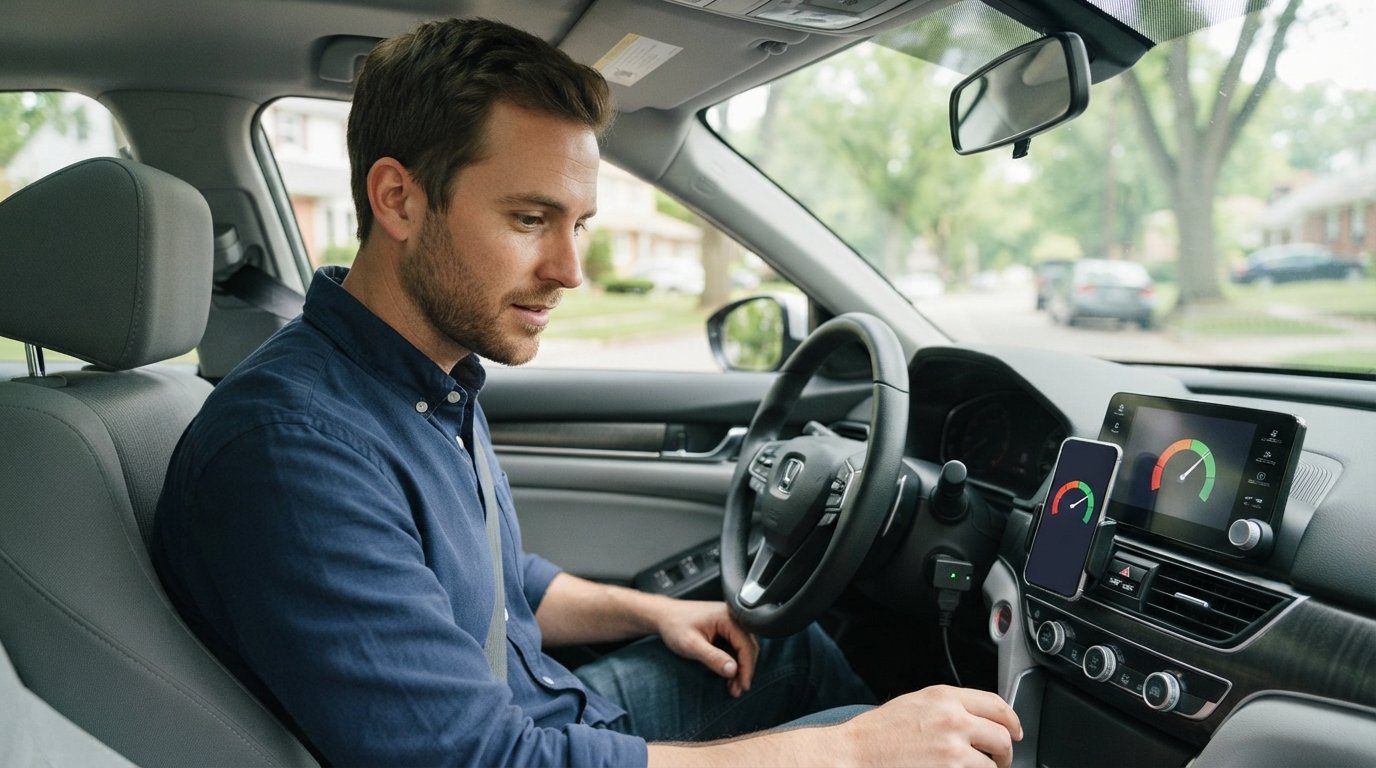
Usage based programs collect data in one of two ways: a plug-in device that connects to your car's onboard diagnostics port, or a smartphone app that uses GPS and motion sensors. Both methods capture a stream of information about when, where, and how you drive. The insurer then runs that data through a scoring model that produces a discount, a surcharge, or a neutral result at the end of a monitoring period, which typically lasts three to six months.
The specific metrics vary by carrier, but most scoring models focus on a handful of core behaviors. Mileage is the most obvious: the fewer miles you drive, the lower your exposure to accidents. Time of day matters because late-night and early-morning driving correlates with higher crash risk. Hard braking, rapid acceleration, and sharp cornering are treated as proxies for aggressive or distracted driving. Phone handling, such as unlocking the screen or tapping while the vehicle is moving, has become a major factor in mobile app programs. Some insurers also track speed relative to posted limits, though this is less common due to data limitations.
What does the scoring look like in practice? A typical program might assign points for each trip and then average them into a weekly or monthly score. Safe braking and smooth acceleration earn positive points, while harsh events subtract from the total. Many apps display a dashboard with a driving score, trip history, and personalized tips. That feedback loop is one of the underappreciated benefits of usage based insurance: it can function as a lightweight driving coach. Drivers who check their scores often report becoming more conscious of following distance and phone use, even when they are not actively trying to earn a discount.
It is important to note that a telematics score is not the same as a credit-based insurance score. Telematics measures behavior behind the wheel, while credit-based insurance scores reflect financial history. Most states allow insurers to use credit information in auto insurance pricing, but usage based programs are separate. A driver with a poor credit-based score might still earn a strong telematics discount, and vice versa. That distinction matters when you are comparing quotes and trying to estimate your final premium.
What Behaviors Raise or Lower a Usage Based Rate
The behaviors that affect your rate fall into two broad categories: those you can control and those you cannot. Controllable behaviors include braking smoothness, acceleration habits, phone handling, and the miles you choose to drive. Less controllable factors include your work schedule, the traffic density in your area, and whether you live in a region with frequent severe weather. Insurers know that not every harsh braking event is a sign of aggression; sometimes it is the only safe response to a sudden obstacle. Still, the scoring models are built on patterns, and a single hard stop is unlikely to sink your score. Consistency is what matters.
Here is a breakdown of the most common behaviors and how they typically influence a usage based rate:
- Low annual mileage: Driving fewer than 8,000 to 10,000 miles per year is one of the strongest predictors of a discount. Some pay-per-mile programs charge a base rate plus a few cents per mile, which can be very cheap for infrequent drivers.
- Smooth braking and acceleration: Gradual stops and starts signal a careful driver. Repeated hard braking events, especially at high speeds, tend to lower your score.
- Daytime driving: Most trips between 7 a.m. and 7 p.m. are viewed more favorably than late-night driving. If you work a night shift, expect that pattern to count against you in some programs.
- No phone handling: Picking up your phone while the car is in motion is one of the fastest ways to lose points in app-based programs. Mounting your phone and using hands-free features helps.
- Consistent driving patterns: Erratic schedules and frequent short trips can be harder to score favorably than a predictable commute, though short trips also mean fewer miles overall.
The flip side is equally important. Behaviors that raise your rate include high annual mileage, frequent hard braking, rapid acceleration, late-night driving, and phone distraction. Some programs also penalize very high speeds, though enforcement varies. If you regularly drive in dense urban traffic, you may experience more harsh braking events simply because of the environment, not because you are a bad driver. That is one reason usage based programs are not a perfect fit for everyone. A driver in a rural area with light traffic may score better on the same behavior than a driver in a crowded city.
It also helps to understand how the discount is applied. Most programs offer a participation discount just for signing up, often 5 to 10 percent, and then a larger discount at renewal based on your driving score. The maximum discount can range from 10 to 30 percent or more, depending on the carrier and state. Some programs are structured as pay-per-mile, where you pay a lower base rate and then a per-mile charge. In those cases, the biggest lever is simply how much you drive. If you are retired, work from home, or live in a walkable neighborhood, a pay-per-mile plan can be dramatically cheaper than a traditional policy.
Privacy and Data-Sharing Considerations
Usage based insurance requires you to share driving data with your insurer, and that raises legitimate privacy questions. What exactly is collected? How long is it stored? Who can see it? The answers vary by program, but most insurers publish a telematics privacy notice that explains the scope. Typical data includes GPS location, trip start and end times, speed, acceleration, braking, and phone sensor data if you use a mobile app. Some programs collect only summarized scores rather than raw trip data, while others retain detailed logs for a set period.
Before enrolling, review the consent language carefully. Look for whether the insurer shares data with third parties, whether it uses the data for purposes beyond pricing (such as claims investigation), and whether you can opt out and delete your data after the program ends. In some states, insurers are restricted in how they can use telematics data, and a few states have specific rules about usage based insurance. If privacy is a top concern, a plug-in device that records only mileage and basic driving events may feel less intrusive than a smartphone app that tracks location continuously.
There is also the question of data security. Telematics data is personal, and insurers are subject to state data protection laws, but breaches can happen. Ask your agent or read the program terms to understand how data is encrypted and stored. If you are uncomfortable with continuous monitoring, consider a program that offers a short evaluation period and then lets you decide whether to continue. Many carriers allow you to unenroll after the monitoring period if the discount does not materialize.
Who Tends to Benefit Most from Usage Based Programs
Usage based car insurance is not a universal money-saver. The drivers who benefit most tend to share a few characteristics. They drive fewer miles than average, they avoid late-night trips, and they keep their phone out of reach while driving. Retirees, remote workers, and urban residents who rely on public transit often fall into this group. For them, a pay-per-mile or telematics discount can cut premiums by 20 percent or more compared with a traditional policy.
On the other hand, drivers who log 15,000 miles a year, commute at night, or live in stop-and-go traffic may see little benefit or even a surcharge. That does not mean they should automatically avoid usage based insurance. Some programs cap surcharges or offer a participation discount that offsets a lower score. The key is to read the program details and, if possible, use a quote comparison tool to see how the estimated discount compares with a traditional policy. You can also ask the insurer for a sample calculation based on your typical driving patterns.
Another group that benefits is safe drivers who have been penalized by traditional rating factors. For example, a driver with a prior at-fault accident may still pay a higher base rate, but a strong telematics score can earn a discount that softens the impact. Similarly, younger drivers, who often face high premiums due to statistical risk, can use a usage based program to demonstrate responsible behavior and lower their costs over time. That said, young drivers should be cautious: some programs may reveal risky habits that lead to higher rates, so parental involvement and clear expectations help.
When you are ready to compare options, start by gathering quotes from multiple carriers. InsuranceShopping.com offers educational guides and connection tools that can help you understand auto insurance basics and request quotes from licensed agents. You can also visit QuoteComparison to explore side-by-side quote resources for auto and other coverage types. And if you want to understand whether rates are uniform across carriers, our guide on whether car insurance rates are the same explains why shopping around matters.
How to Decide If a Usage Based Program Is Right for You
Making the decision comes down to a simple cost-benefit analysis. First, estimate your annual mileage and your typical driving hours. If you drive less than 10,000 miles a year and rarely drive after dark, the odds of a meaningful discount are good. Second, review the program's privacy terms and decide whether the data collection feels acceptable. Third, check whether the insurer offers a participation discount and whether surcharges are capped. Finally, compare the projected usage based premium with at least two traditional quotes.
It also helps to think about your tolerance for monitoring. Some drivers find the feedback motivating and enjoy watching their score improve. Others find it intrusive or stressful. Neither reaction is wrong; it is a personal preference. If you decide to enroll, give the program a full monitoring period before judging the results. Early scores can be noisy, and a single road trip or a few days of unusual traffic can skew the average. Most insurers use a rolling average or a final score that smooths out short-term anomalies.
Keep in mind that usage based insurance is just one lever for lowering your auto premium. Raising your deductible, bundling auto and home coverage, maintaining a clean claims history, and improving your credit can all have a larger impact for some drivers. Usage based programs work best when combined with those fundamentals. They are not a substitute for shopping around, and they are not a guarantee of savings. But for the right driver, they can turn everyday habits into a tangible discount.
As telematics technology improves and more states clarify their rules, usage based car insurance is likely to become even more common. The smartest approach is to stay informed, read the fine print, and treat your driving data as a financial asset. If you drive carefully and infrequently, you may be able to turn those habits into lower rates. If you drive a lot, you can still use the information to avoid surcharges and make better decisions at renewal. Either way, understanding how driving habits affect rates puts you in control of the conversation with your insurer.