
Rideshare Insurance for Uber and Lyft Drivers: Coverage Gaps
Rideshare insurance for Uber and Lyft drivers coverage gaps leave you exposed. Call (833)-214-6397 to compare endorsements and close the gaps.

By Seren Whitlock
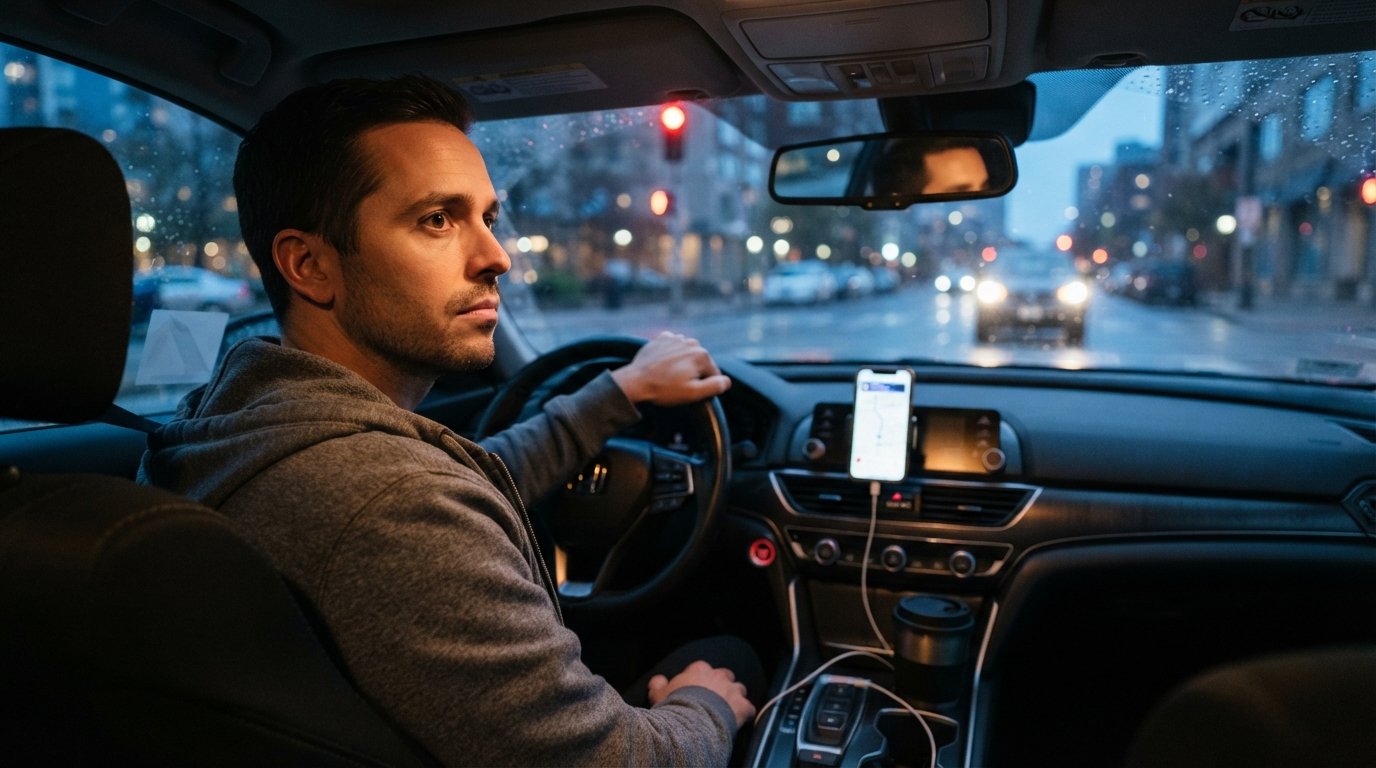
You are sitting at a red light, waiting for the next ride request to ping your phone. In that quiet moment, have you ever wondered exactly whose insurance would pay if another driver slammed into you right now? If you drive for Uber or Lyft, the answer is more complicated than most people realize. Your personal auto policy, the rideshare company's commercial policy, and your own rideshare endorsement all interact in ways that leave specific windows of time underinsured or completely uninsured. Understanding these rideshare insurance for Uber and Lyft drivers coverage gaps is not optional trivia; it is the difference between a claim that gets paid and a financial catastrophe that lands on your doorstep.
The core problem is that three different insurance systems turn on and off depending on what you are doing at any given second. Personal auto insurance usually excludes commercial use. Uber and Lyft provide contingent liability coverage that only activates at certain stages. And a rideshare endorsement (if you buy one) fills some gaps but rarely all of them. When those three systems do not overlap perfectly, you get coverage gaps. This guide walks through each phase of a typical driving session, explains what is covered and what is not, and shows you how to close the gaps without overpaying for duplicate protection.
The Three Phases of a Rideshare Trip and What Each One Covers
Insurance companies divide a rideshare driver's workday into three distinct periods. Phase 1 is when the app is on but you have not accepted a ride request. Phase 2 is when you have accepted a request and are driving to pick up the passenger. Phase 3 is when the passenger is in your vehicle and you are driving to the destination. Each phase carries different levels of risk and different levels of insurance protection, and the gaps tend to appear in Phase 1 and sometimes in Phase 2.
During Phase 1, Uber and Lyft typically provide only contingent liability coverage, and that coverage usually kicks in only after your personal policy has paid its limits or denied the claim entirely. In many states, the rideshare company's Phase 1 liability limit is relatively low, often $50,000 per person and $100,000 per accident for bodily injury, with $25,000 for property damage. That is far below what a serious accident can cost. If you are at fault in Phase 1 and the other driver suffers a severe injury, the rideshare policy may pay its limit and leave you personally responsible for the rest. Your personal auto policy may deny the claim altogether because you were using the vehicle for commercial purposes, even though you had not accepted a ride yet.
Phase 2 and Phase 3 are better protected. Once you accept a ride request, Uber and Lyft generally provide commercial liability coverage with limits of at least $1 million per accident in most states. That covers bodily injury and property damage to third parties. However, this commercial coverage typically does not include collision or comprehensive coverage for your own vehicle. If you hit a pothole and damage your bumper while driving to pick up a passenger, the rideshare company's policy will not pay to fix your car. You need your own collision coverage for that, and your personal policy may still deny the claim if it excludes commercial use.
Here is a quick breakdown of the three phases and the typical coverage picture:
- Phase 1 (app on, no request accepted): Rideshare company provides low-limit contingent liability only. Personal policy may deny. Your vehicle damage is usually uncovered.
- Phase 2 (request accepted, en route to pickup): Rideshare company provides $1 million commercial liability. Collision and comprehensive for your car may still be missing unless you have a rideshare endorsement.
- Phase 3 (passenger in car): Rideshare company provides $1 million commercial liability. Same collision and comprehensive gap applies to your own vehicle.
The gap that catches most drivers off guard is the collision and comprehensive coverage during Phases 2 and 3. Imagine you are driving a passenger to the airport and a deer runs into your car. The rideshare company's liability coverage does not apply because there is no third-party injury or property damage claim. Your personal auto policy might deny the claim because you were driving for hire. Without a rideshare endorsement that extends your collision and comprehensive coverage into commercial use, you would pay for the repair out of pocket. That is a coverage gap that costs drivers thousands of dollars every year.
Why Personal Auto Policies Exclude Rideshare Driving
Standard personal auto policies are priced for personal use. The insurance company calculates your premium based on how many miles you drive for personal errands, commuting, and occasional road trips. When you start driving for Uber or Lyft, you are on the road far more hours, you are driving in unfamiliar areas, and you are exposing the insurer to commercial liability that it never agreed to cover. That is why almost every personal auto policy includes a business or commercial use exclusion. If you are in an accident while driving for a rideshare company, the insurer can deny your claim entirely, even if you were not at fault.
Some drivers try to hide their rideshare work from their insurer. That is a mistake. If the insurer discovers the commercial use during a claim investigation, it can rescind the policy or deny coverage. You could be left paying for the other driver's injuries, your own medical bills, and your vehicle repair without any insurance help. Worse, a denied claim for commercial use can follow you when you try to buy insurance in the future. Honesty about your driving habits is the foundation of reliable coverage.
The good news is that many insurers now offer a rideshare endorsement that modifies the personal policy to cover commercial use. This endorsement is not available in every state, and not every insurer offers it, but it is the cleanest way to close the gap between personal and commercial coverage. When you add a rideshare endorsement, your personal policy agrees to cover you during all three phases of a rideshare trip, often including the collision and comprehensive coverage that the rideshare company does not provide. You still need to notify your insurer that you drive for Uber or Lyft, but with the endorsement in place, you do not have to worry about a denial based on commercial use.
If your insurer does not offer a rideshare endorsement, you have a few options. You can switch to an insurer that does. You can buy a separate commercial auto policy, though that is often expensive and may duplicate coverage you already have. Or you can rely on the rideshare company's coverage and accept the gaps, which is risky. In our guide on cost of couples health insurance average USA, we explain how health coverage interacts with auto claims, which is relevant if you are injured in a rideshare accident and need to understand how your medical bills get paid.
Uninsured and Underinsured Motorist Coverage Gaps
Uninsured and underinsured motorist coverage (UM/UIM) is another area where rideshare drivers face gaps. This coverage pays for your injuries and sometimes your vehicle damage when the at-fault driver has no insurance or too little insurance to cover your losses. During Phase 1, the rideshare company's contingent liability coverage may include UM/UIM, but the limits are often low. During Phases 2 and 3, the rideshare company's commercial policy may include UM/UIM, but the coverage may not extend to your own vehicle damage. Your personal UM/UIM coverage might not apply because of the commercial use exclusion.
Consider a scenario: You are driving a passenger to her destination when another driver runs a red light and hits you. The other driver has no insurance. You suffer a broken arm and your car is totaled. The rideshare company's commercial policy may pay for your medical bills under its UM/UIM coverage, but it may not pay to replace your car. Your personal policy might deny the collision claim because you were driving for hire. Without a rideshare endorsement that includes UM/UIM and collision coverage, you could be stuck with medical bills and no vehicle. This is a gap that many drivers do not discover until it is too late.
To close this gap, look for a rideshare endorsement that extends your personal UM/UIM and collision coverage into all phases of rideshare driving. If your insurer does not offer such an endorsement, consider switching to one that does. Some insurers offer a dedicated rideshare policy that combines personal and commercial coverage in one package. These policies are designed specifically for drivers who split their time between personal and commercial use. They may cost more than a standard personal policy, but they eliminate the gaps that can wipe out your savings.
Health Insurance and Medical Payments Coverage for Rideshare Drivers
If you are injured in a rideshare accident, your health insurance may be your primary source of medical coverage. However, health insurance does not pay for everything. It may have deductibles, copays, and out-of-network restrictions. It may also deny claims if the injury occurred during a commercial activity, depending on the policy language. That is why medical payments coverage (MedPay) or personal injury protection (PIP) on your auto policy is so important. MedPay and PIP pay for medical expenses regardless of who is at fault, and they can fill the gap between what health insurance pays and what you actually owe.
During Phase 1, the rideshare company's contingent liability coverage may not include MedPay or PIP. During Phases 2 and 3, the commercial policy may include some medical coverage, but it may be limited. Your personal auto policy may include MedPay or PIP, but the commercial use exclusion could bar the claim. A rideshare endorsement that extends MedPay or PIP into commercial use is a valuable addition. It ensures that your medical bills get paid while you recover, without waiting for a liability determination or a health insurance approval.
Health insurance and auto insurance interact in complex ways after an accident. In some states, PIP is the primary payer and health insurance is secondary. In others, health insurance pays first and PIP covers the remainder. Understanding your state's rules is essential. If you are self-employed or buy your own health coverage, you may already be familiar with the challenges of finding affordable plans. The same principles of comparing options and understanding coverage gaps apply to both health and auto insurance. For a deeper dive into how health coverage works for couples and self-employed individuals, the guide mentioned earlier provides useful context.
If you are looking for a trusted resource to compare auto, health, and other insurance options, InsuranceAdvisers offers educational tools and connections to licensed agents who can help you find the right coverage. Whether you need a rideshare endorsement, a commercial auto policy, or a health plan that works with your driving schedule, comparing multiple quotes is the best way to avoid gaps and control costs.
How to Close the Gaps: A Step-by-Step Approach
Closing rideshare insurance coverage gaps requires a deliberate approach. You cannot rely on the rideshare company alone, and you cannot assume your personal policy will protect you. The following steps will help you identify and fill the gaps in your coverage.
- Review your personal auto policy. Look for the business or commercial use exclusion. Check whether your insurer offers a rideshare endorsement. If it does, get a quote and add it to your policy.
- Understand the rideshare company's coverage. Read Uber's and Lyft's insurance summaries carefully. Note the limits for each phase and the types of coverage provided. Identify what is missing, especially collision, comprehensive, and UM/UIM.
- Compare rideshare endorsements and commercial policies. Get quotes from multiple insurers. Compare the cost of an endorsement versus a standalone commercial policy. Look for coverage that extends to all three phases and includes collision, comprehensive, MedPay, and UM/UIM.
- Coordinate with your health insurance. Confirm how your health plan handles accident-related claims. Consider adding MedPay or PIP to your auto policy if you do not already have it.
- Review your coverage annually. Rideshare company policies and state regulations change. Your personal circumstances change too. Review your coverage every year or after any major life event.
Following these steps will not eliminate every risk, but it will reduce the chances that a single accident destroys your financial stability. The key is to be proactive. Do not wait until after an accident to discover that your coverage has a gap. By then, it is too late to fix the problem.
Another important consideration is your vehicle's value and your ability to pay for repairs or replacement. If you drive a newer car, collision and comprehensive coverage are essential. If you drive an older car that is not worth much, you might decide to skip collision coverage and self-insure that risk. But remember that the rideshare company's liability coverage does not pay for your car, so if you skip collision, you are accepting the risk of paying for repairs yourself. Make that decision consciously, not by accident.
State Variations and Regulatory Changes
Rideshare insurance rules vary significantly from state to state. Some states require rideshare companies to provide higher limits during Phase 1. Some states require rideshare companies to offer collision coverage during Phases 2 and 3. Some states have mandated that personal auto insurers offer rideshare endorsements. Knowing your state's rules is essential because the gaps may be larger or smaller depending on where you drive.
For example, in California, rideshare companies must provide $200,000 per person and $400,000 per accident in liability coverage during Phase 1, which is higher than the minimum in many other states. In Texas, the Phase 1 limits are lower, but the state has specific rules about how personal policies must handle rideshare use. In New York, rideshare drivers are covered by a special commercial policy that includes disability benefits and other protections. These variations mean that a one-size-fits-all approach to rideshare insurance does not work. You need to understand the rules in your state and choose coverage accordingly.
Regulatory changes can also create new gaps or close existing ones. Some states have considered legislation to require rideshare companies to provide collision coverage during all phases. Others have considered requiring personal insurers to offer rideshare endorsements. If you drive in a state where the rules are changing, stay informed. The InsuranceShopping.com blog and similar resources can help you track updates that affect your coverage. The site publishes insurance news and educational content that addresses regional variations and timely consumer needs, making it a useful tool for drivers who want to stay ahead of the curve.
One more factor to consider is the deductible on your collision coverage. If you have a $1,000 deductible and you damage your car in a Phase 2 accident, you will pay the first $1,000 out of pocket before your insurance kicks in. Some rideshare endorsements reduce or eliminate the deductible during commercial use. Others do not. Read the fine print and choose an endorsement that matches your risk tolerance and budget. A higher deductible lowers your premium but increases your out-of-pocket cost after an accident. A lower deductible costs more upfront but protects you better when you need to file a claim.
Building a Comprehensive Coverage Strategy
Rideshare insurance for Uber and Lyft drivers coverage gaps is not a single problem with a single solution. It is a collection of risks that require a layered approach. Your personal auto policy, the rideshare company's commercial policy, a rideshare endorsement, your health insurance, and possibly a commercial auto policy all work together to protect you. The goal is to make sure that every phase of your driving session is covered by at least one policy, and that the limits are high enough to protect your assets.
Start by talking to your current insurer. Ask specifically about rideshare endorsements and commercial use exclusions. If your insurer cannot meet your needs, shop around. Compare quotes from multiple companies, and do not be afraid to ask detailed questions about how each policy handles Phase 1, Phase 2, and Phase 3. A licensed agent can help you understand the nuances and choose a policy that fits your driving patterns.
Remember that the cheapest policy is not always the best policy. Saving a few dollars a month on premiums can cost you thousands of dollars after an accident if your coverage has gaps. The right policy is the one that protects you, your passengers, and your vehicle without leaving you exposed. Take the time to review your options, ask questions, and make an informed decision. Your financial security depends on it.